Boardroom Definition
Attribution is the measurement science of assigning credit to the various marketing channels and interactions (e.g., clicks, views, opens) that influence a consumer’s decision to convert. It allows marketers to understand the causal relationship between advertising exposure and business outcomes, enabling data-driven budget allocation across the media mix.
Attribution relies on probability and logic sequences rather than a single universal formula. It functions by distributing a value of 1.0 (100% credit) across a set of events.
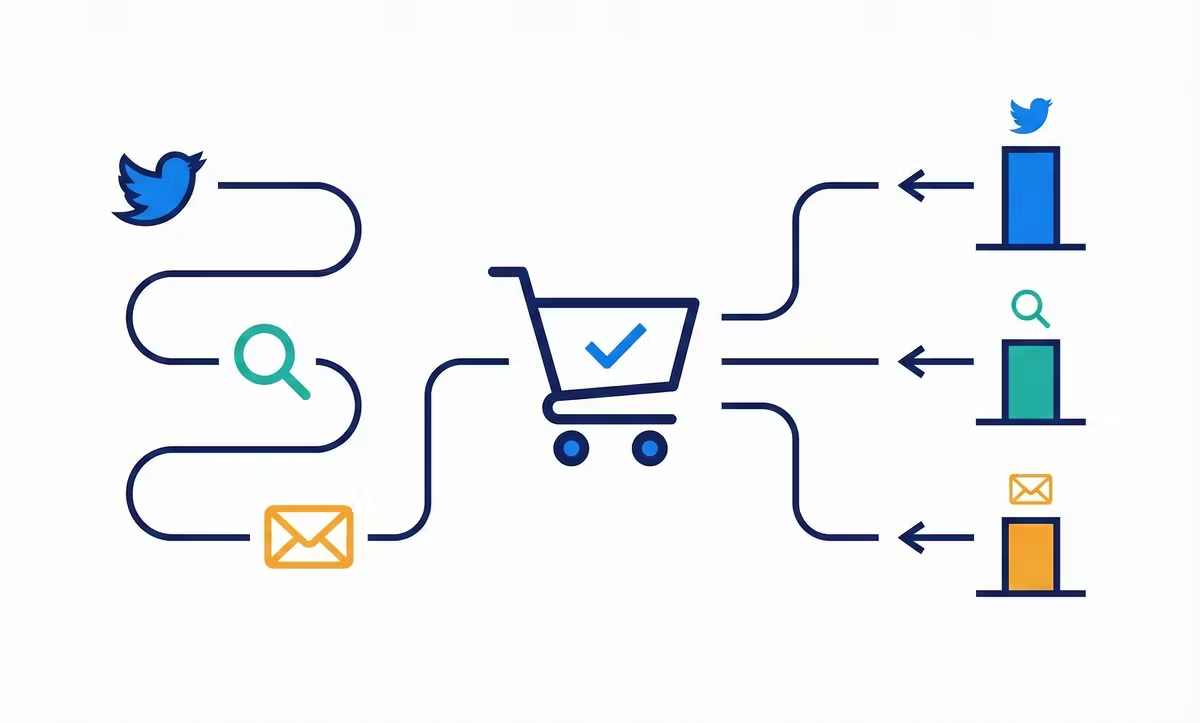
- The Logic Sequence: If a user sees an Instagram Ad, Clicks a Google Search Ad, then converts, attribution determines how the value of the conversion is split between Instagram and Google.
- Binary Attribution: Assigns the full integer (1.0) to a single variable (e.g., Google gets 100%, Instagram gets 0%).
- Fractional Attribution: Divides the integer based on weight (e.g., Instagram gets 0.4, Google gets 0.6).
The Real Scoop
Attribution is the most contentious topic in media strategy because it is not an exact science. It is a negotiation of truth. In 2026, the "perfect" tracking capability has been eroded by privacy regulations, cookie deprecation, and intelligent tracking prevention (ITP).
Consequently, attribution has shifted from a deterministic tracking exercise to a probabilistic one. The "Real Scoop" is that no single platform tells the whole truth. "Walled Gardens" (like Google and Meta) are incentivized to grade their own homework, often claiming credit for conversions that might have happened anyway. Experienced directors rarely rely on a single attribution source; instead, they triangulate data from platform reports, backend sales data (e.g., Shopify), and incrementality testing.
Watch Outs
- Double Counting: A common pitfall where the sum of conversions reported by individual platforms (e.g., Meta + Google + TikTok) exceeds the actual sales recorded in the CRM. This happens because multiple platforms often claim credit for the same customer journey.
- The "View-Through" Illusion: Be wary of vendors boasting high attribution numbers based heavily on "View-Through" conversions with long lookback windows (e.g., 30 days). This can assign credit to ads that users scrolled past but never actually noticed.
- Last-Click Bias: Relying solely on "Last-Click" attribution ignores the brand-building work done by upper-funnel formats (like Video or Connected TV), potentially leading you to cut the very channels that are feeding your demand.