Boardroom Definition
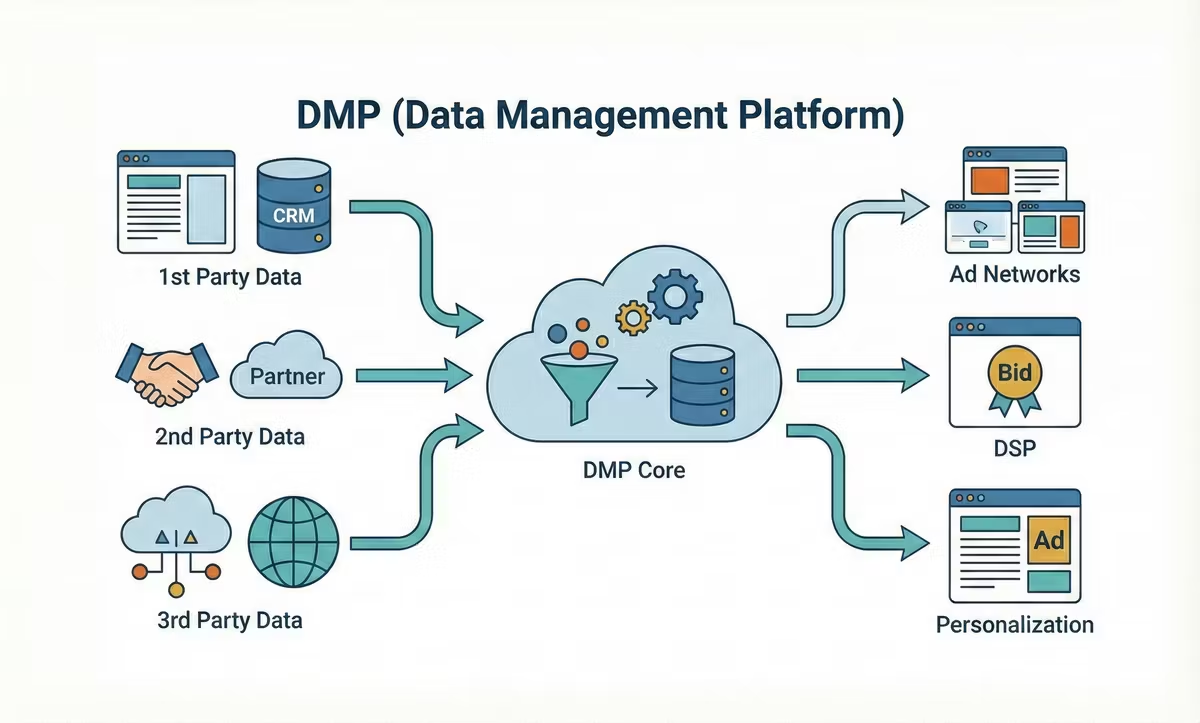
A Data Management Platform (DMP) is a unifying software system that collects, organizes, and activates audience data from various sources. Its primary function is to ingest first-party data (website visitors), second-party data (partner data), and third-party data (purchased marketplaces) to construct anonymous user profiles. These profiles are then grouped into "segments" (e.g., "Auto Intenders") and pushed to a DSP (Demand Side Platform) for ad targeting.
The core utility of a DMP is Lookalike Modeling (LAM). This uses algorithmic regression to find new users who statistically resemble your existing best customers.
Expansion Logic: The algorithm identifies common variables (features) within a "Seed Audience" (e.g., Converters) and scans the "Universe" (Total Available Audience) for matching patterns.
Boolean Segmentation Logic: DMPs rely on Boolean operators to refine audience value:
- AND: (Visited Site) AND (Viewed Pricing) = High Intent.
- OR: (Visited Site) OR (Clicked Email) = Broad Reach.
- NOT: (Visited Site) NOT (Converted) = Retargeting Pool.
The Real Scoop
In 2026, the traditional DMP is a technology in decline, largely superseded by the CDP (Customer Data Platform).
The "Insider" reality is that DMPs were built on the foundation of the Third-Party Cookie. With the deprecation of cookies by major browsers (Chrome, Safari), the DMP's ability to track users across the web has been crippled.
However, they remain useful for Publisher Data. Large media owners (like NBCU or The New York Times) use DMPs to package their own audiences to sell to advertisers. For a brand, however, relying solely on a DMP in 2026 is a strategy with a shelf life. The pivot is toward CDPs, which manage "Known Users" (email addresses/PII) rather than the DMP's "Anonymous Cookies."
Watch Outs
- Data Decay: Third-party cookie segments have a short half-life. A user flagged as an "Auto Intender" 30 days ago may have already bought a car, but the DMP still categorizes them as a prospect, leading to wasted spend.
- Taxonomy Nightmares: Without strict naming conventions, DMPs become data swamps. "Segment_New_Final_V2" means nothing six months later. Strict governance is required.
- The "Tech Tax": DMPs are expensive enterprise software. If you are not spending significantly on media (often $5M+ annually) to activate that data, the platform fee often outweighs the efficiency gains.