Boardroom Definition
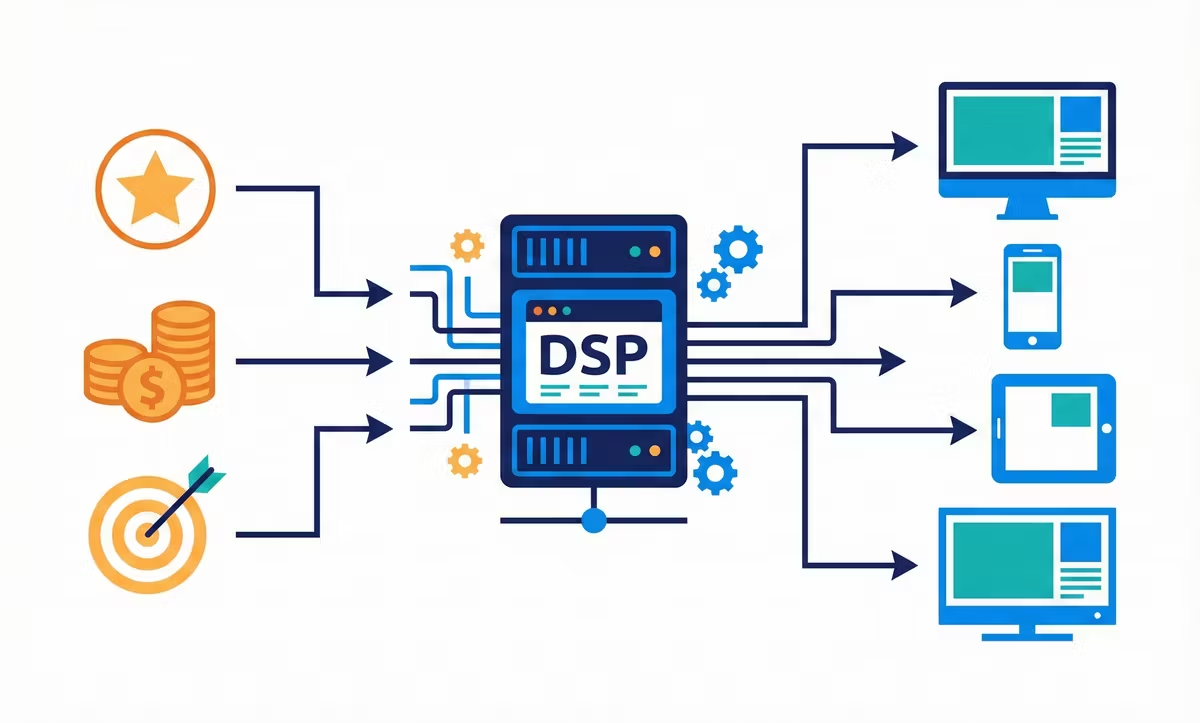
A Demand Side Platform (DSP) is a technology platform that enables advertisers and agencies to purchase and manage digital media inventory from multiple ad exchanges and Supply Side Platforms (SSPs) through a single interface. It utilizes real-time bidding (RTB) algorithms to evaluate individual impressions in milliseconds and execute buys based on specific targeting criteria, budget constraints, and optimization goal.
The core function of a DSP is the Bid Decisioning Logic, which calculates the value of an impression in real-time.
- The Auction Mechanics:
- Second-Price Auction: If you bid $5.00 and the next highest bidder is $3.00, you pay $3.01.
- First-Price Auction: If you bid $5.00, you pay $5.00 (Standard in 2026).
- Budgeting Application: To prevent overspending in a DSP, planners use reverse calculation to set a "Bid Ceiling."
- Formula: Budget / Required Impressions = Max Bid Cap
The Real Scoop
Think of a DSP like a stock market trading terminal for ads. Before DSPs, media buying required human negotiation and manual insertion orders. Today, the DSP is the "cockpit" where the strategy lives.
The critical "insider" reality is that not all DSPs have the same access. While most connect to the major exchanges (Google AdX, Magnite, PubMatic), some DSPs (like Amazon or Google's DV360) have "privileged access" to their own proprietary inventory (O&O) that is not available elsewhere. Furthermore, in 2026, the differentiator is no longer just access to inventory, but the quality of the AI "brain" optimizing the buy. Deciding which impressions to ignore is just as important as which ones to buy.
Watch Outs
- The "Tech Tax": DSPs are not free. They typically charge a "Platform Fee" (often 10–20% of media spend) on top of the media cost. When calculating ROI, you must distinguish between "Working Media" (money that buys ads) and "Non-Working Media" (fees).
- Arbitrage (The "Black Box"): Some managed-service DSPs do not disclose their fees, opting instead for an "arbitrage" model where they buy low and sell to you high, pocketing the difference. Always demand fee transparency.
- Learning Phases: A DSP's algorithm requires data to function. Launching a campaign with a tiny budget ($500) often fails because the DSP cannot gather enough statistical significance to optimize the bid effectively.
External Resources
- The Trade Desk / Google DV360: Examples of market-leading DSP technology.
- Interactive Advertising Bureau (IAB): Guidelines on Programmatic Fee Transparency.
- Association of National Advertisers (ANA): Reports on the Programmatic Supply Chain.