Boardroom Definition
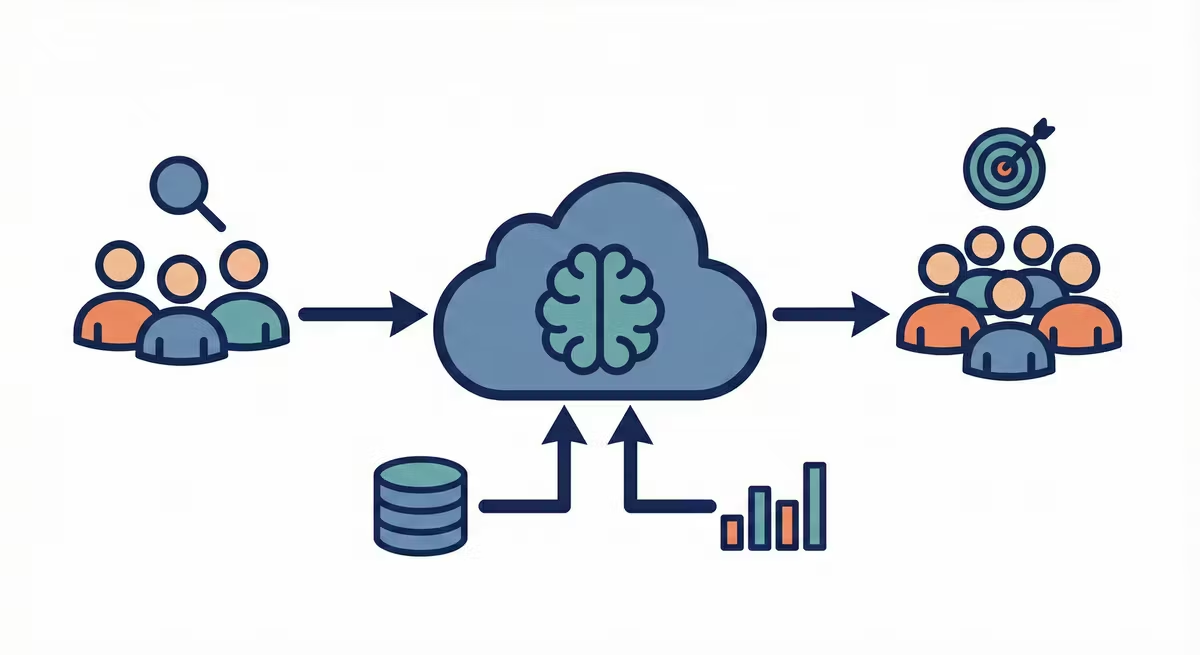
A Lookalike Audience (often abbreviated as LAL or LLA) is a prospecting group constructed by machine learning algorithms. The system analyzes a "Seed Audience" (typically First Party Data like a customer email list or site visitors) to identify commonalities in behavior, demographics, and interests. It then finds other users within the platform's ecosystem who share these traits but have not yet interacted with the brand. This allows advertisers to scale their reach beyond their owned data while maintaining a high probability of relevance.
The core mechanics of Lookalike modeling rely on Vector Similarity and Percentile Scoring.
The Similarity Function:
Platforms map users in a multi-dimensional feature space (age, location, click history, interests). The algorithm calculates the distance between the "Seed" user vectors and the general population vectors.
$$Similarity Score \approx \frac{A \cap B}{A \cup B}$$
(Simplified Jaccard Index logic: The intersection of shared traits divided by the union of all traits.)
The Percentile Trade-Off:
Lookalikes are defined by size percentages (e.g., 1%, 5%, 10%) of the total population in a specific country.
- 1% LAL: The top 1% of users who most closely match the seed. Highest Similarity, Lowest Reach.
- 10% LAL: The top 10% of users. Lower Similarity, Highest Reach.
The Real Scoop
Lookalike Audiences are the primary engine for scaling First Party Data1. While simple interest targeting (e.g., "People who like Golf") is broad and often inaccurate, Lookalikes leverage thousands of data points simultaneously to find "people who act like my customers."
The "Insider" reality is that the quality of the model is entirely dependent on the homogeneity of the Seed Audience. An "All Site Visitors" seed is often weak because it mixes high-value purchasers with people who bounced immediately. The most effective Lookalikes come from "Value-Based Seeds"specifically, the top 20% of customers by Lifetime Value (LTV). In 2026, as signal loss degrades tracking, platforms like Meta and TikTok rely heavily on their own on-platform data to fill in the gaps for these models.
Watch Outs
- Garbage In, Garbage Out: If your seed list is small (<1,000 matched users) or messy, the algorithm cannot find a statistically significant pattern. The result will be a low-performing, generic audience.
- Audience Overlap: When running multiple Lookalikes (e.g., 1% vs. 3%), they often contain the same users. You must exclude the 1% audience from the 3% ad set to prevent bidding against yourself.
- The "Static Seed" Trap: Customer behavior changes. If you do not refresh your seed list dynamically (via an API or CAPI connection), the model will continue optimizing for the type of customer you had six months ago, not the one you want today.