Boardroom Definition
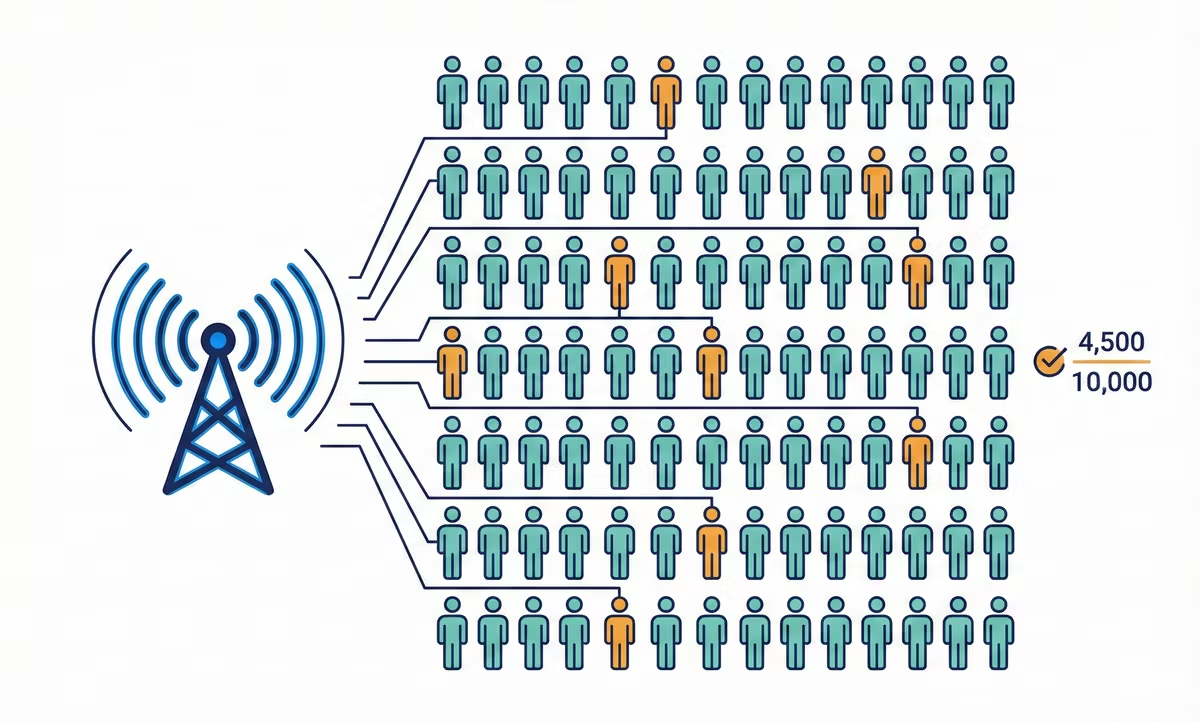
Reach quantifies the breadth of an advertising campaign's audience. Unlike impressions, which count every single view regardless of who is viewing, Reach counts unique identities. If one person sees an advertisement five times, it counts as five impressions but only a reach of one. It is often expressed either as a raw number (e.g., "We reached 5 million uniques") or as a percentage of a defined target universe (e.g., "We reached 40% of Adults 25-54 in the NY DMA").
Reach is inextricably linked to Frequency (the average number of times a reached individual sees the ad) and total Impressions.
Standard Formulas:
- Reach (Raw): Total Impressions / Average Frequency
- Reach (%): (Unique Audience Count / Total Defined Target Universe Population) x 100
- GRPs (Gross Rating Points): Reach % x Average Frequency
The Reach Curve: The relationship between media spend and reach is non-linear. It follows a curve of diminishing returns. The first 50% of a target audience is relatively inexpensive to reach. The next 30% costs significantly more per person, and the final 20%—the hardest-to-reach segments—requires exponential investment. Media investment decisions must weigh the cost of incremental reach against potential campaign lift.
The Real Scoop
In the fragmented digital landscape of 2026, true "person-level" reach is the industry's most significant challenge. Historically, digital reach was based on cookies or device IDs. Consequently, a single user owning a smartphone, a laptop, and a Connected TV (CTV) was often counted as three distinct "reached" units, artificially inflating reach metrics.
Modern sophisticated measurement relies on probabilistic and deterministic cross-device graphing to resolve these disparate IDs into a single user identity. When evaluating vendor reports, veteran directors demand to know the methodology behind the "unique" count. "Device Reach" is virtually useless; "People-Based Reach" is the required standard for accurate planning.
Watch Outs
The Frequency Trade-Off: Maximizing reach often comes at the expense of frequency. A campaign reaching 10 million people with a frequency of 1.2 is rarely as effective as reaching 5 million people with a frequency of 3.5. Reach without sufficient frequency fails to penetrate memory structures.
Universe Definition Errors: Reach percentages are meaningless without a correctly defined "Universe." Claiming "80% Reach" is deceptive if the universe is defined too narrowly (e.g., "Users already visiting our site"). Ensure the denominator represents the total addressable market.
Wasted Reach: Impressions served outside the geographic or demographic target count toward total impressions but are considered "waste" in the context of targeted reach.
External Resources
- Media Rating Council (MRC): Cross-Media Audience Measurement Standards
- Interactive Advertising Bureau (IAB): Audience Reach and Frequency Guidelines