Boardroom Definition
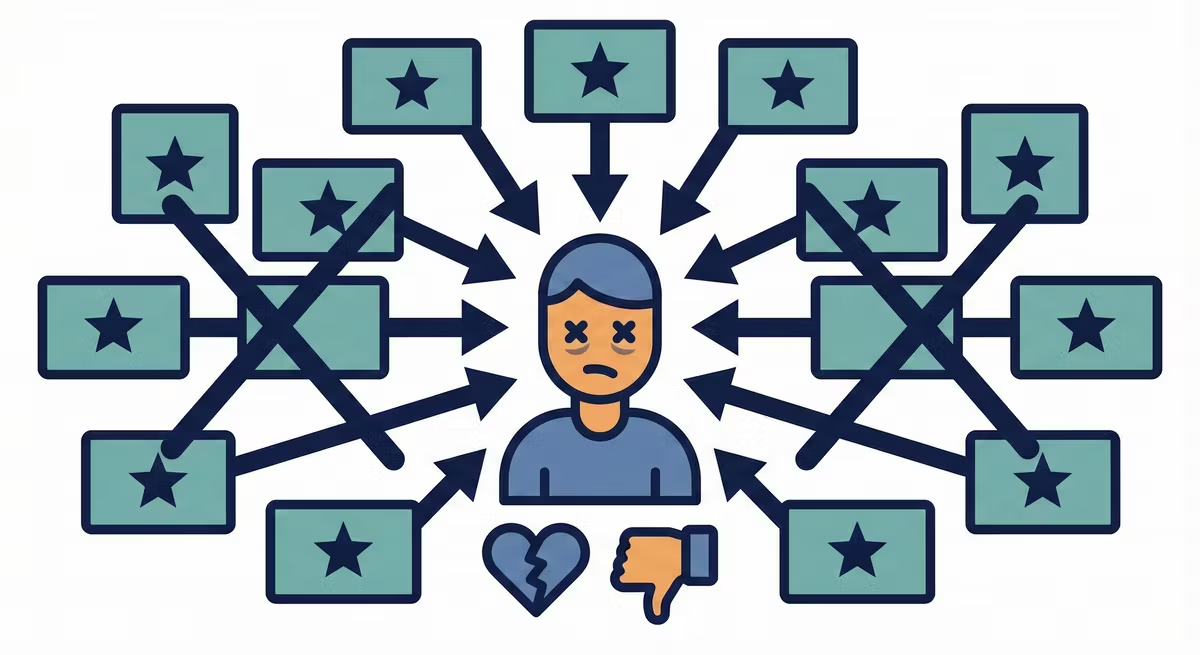
Creative Fatigue (often called Ad Fatigue) is the phenomenon where the effectiveness of an ad campaign diminishes over time because the target audience has seen the message too frequently. It manifests as a drop in engagement metrics (CTR) and a rise in acquisition costs (CPA). Essentially, the audience has mentally "tuned out" the visual stimulus, rendering the media spend inefficient. It is the primary signal that a campaign requires a "Creative Refresh" or a new strategic angle.
Creative Fatigue is mathematically modeled as a Decay Curve. Performance does not drop linearly; it typically follows a logarithmic decay relative to Frequency.
The Fatigue Correlation:
$$CTR \propto \frac{1}{Frequency}$$
As frequency increases, Click-Through Rate (CTR) decreases.
The Decay Formula:
Future Performance = Initial Performance * (1 - Decay Rate) ^ Time
If your daily decay rate is 5% (common in high-spend social campaigns), an ad with a 2.0% CTR on Day 1 will mathematically degrade to ~1.2% CTR by Day 10, assuming the audience pool is finite.
The Real Scoop
In 2026, Creative is the new Targeting.
With the loss of granular third-party data targeting, algorithms (like Meta's Advantage+ or Google's PMax) rely heavily on creative to find users.
In many cases platforms may even penalize fatigue. The algorithm monitors "First Time Impression Ratio." If a user scrolls past your ad twice without stopping, the algorithm deems it "low quality" and stops showing it to similar users, or charges you a premium (higher CPM) to force the impression.
Smart media buyers no longer ask, "How long should this flight run?" They ask, "What is the Half-Life of this creative?" On TikTok, the half-life of an ad might be 4 days. On Connected TV, it might be 4 weeks. You must align your production cycle with the creative decay rate of the specific platform.
Watch Outs
- The "Winner" Bias: Marketers often hesitate to pause their "Best Performing Ad," even as its CPA slowly creeps up. Holding onto a decaying winner often prevents the algorithm from learning on new, fresh assets.
- Visual vs. Conceptual Fatigue: Changing the background color of a banner is Visual variation (weak). Changing the hook, angle, or value proposition is Conceptual variation (strong). Only conceptual changes truly reset the fatigue clock.
- Frequency Saturation: If your Frequency is above 4.0 and performance is dropping, do not increase the budget. Increasing budget into a fatigued pool simply accelerates the waste. You must expand the audience or change the ad.