Boardroom Definition
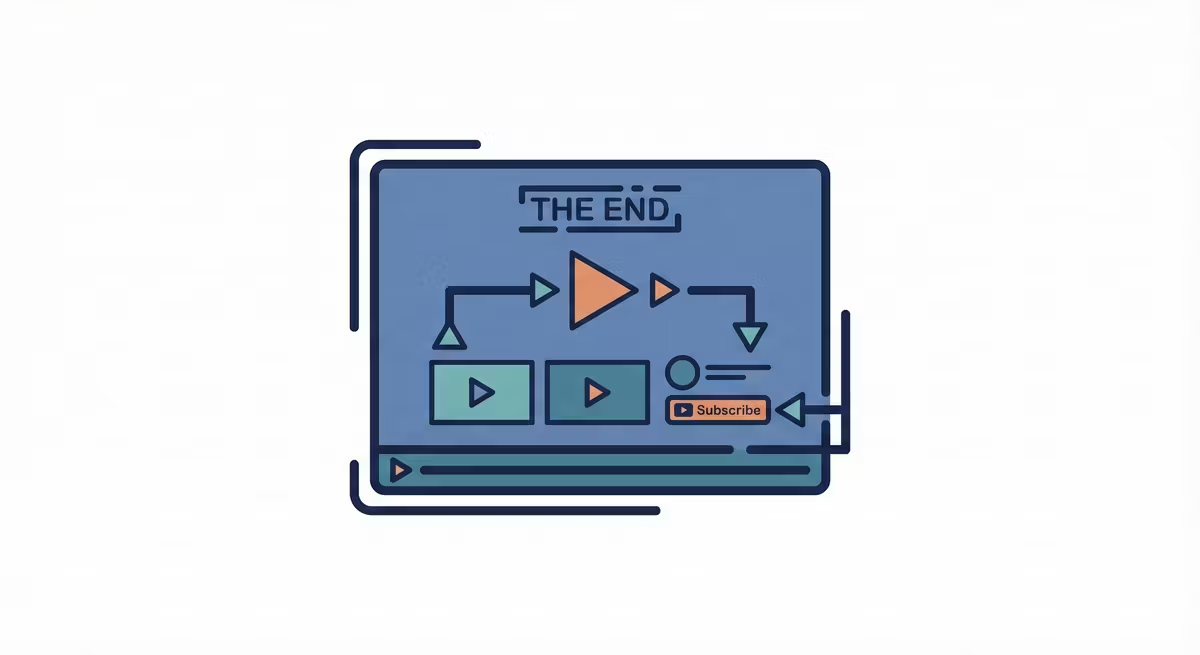
An End Card is a dedicated visual segment, often static or lightly animated that appears at the very end of a video ad. Its primary function is to transition the viewer from passive watching to active participation. It typically contains the brand logo, a clear Call to Action (CTA) button (e.g., Shop Now, Download App), and legally required disclosures. In digital environments, unlike television, the End Card is a clickable interface designed to capture demand generated by the preceding video content.
The performance of an End Card is mathematically isolated from the video itself. It creates a funnel metric known as End Card Conversion Rate.
The Drop-Off Reality:
End Card Impressions \ Net Video Impressions.
Only users who complete the video (or reach the specific time marker) see the card.
End Card Impressions = Total Impressions * Video Completion Rate (VCR)
The Efficiency Formula:
End Card CTR = (Clicks on End Card / End Card Impressions) * 100
If your video has a 10% VCR (Completion Rate) but a 50% End Card CTR, the creative is effective at closing, but the narrative is failing to retain the audience long enough to see the offer.
The Real Scoop
In 2026, the End Card is the digital handshake and its unfortunate but many production agencies often forget to use them. TV commercials end with a fade-to-black or a simple logo. If you run that exact file on YouTube or TikTok, you are wasting some of the valuable seconds of the ad.
Modern platforms like YouTube and TikTok allow for Auto-End Screens, basically native overlays that sit on top of your video file. However, custom-baked End Cards (embedded in the video file) usually perform better because they can be designed to visually direct the eye to the "Skip Ad" or "Learn More" button, using visual cues (arrows, gaze direction) to hack the click-through rate.
Watch Outs
- The Auto-Play Killer: On platforms like TikTok or Instagram Reels, videos often loop or auto-advance to the next video immediately. If your End Card is 5 seconds long, the user might be forced to the next video before they can click. Keep End Cards short (2-3 seconds) and punchy.
- UI Zone Intrusion: Each platform (YouTube Shorts vs. Meta Stories) has different "Safe Zones." Placing your CTA button in the bottom 20% of the screen often means it will be covered by the platform's native playback controls or the "Skip" button, rendering it un-clickable.
- Disjointed Aesthetics: If the video is high-production cinematic footage and the End Card is a jarring, low-res static image, it breaks the immersion and signals "Ad" causing an immediate bounce.