Boardroom Definition
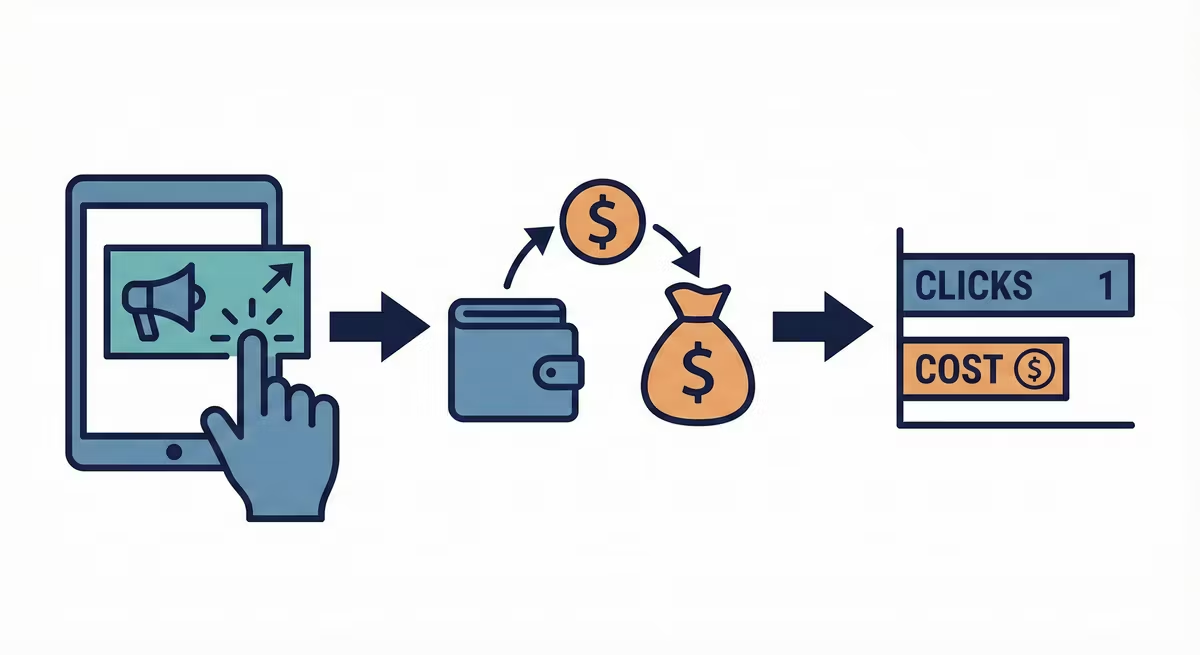
Cost Per Acquisition (CPA) is a financial performance metric that calculates the total advertising spend required to generate a single "action" or conversion. Unlike upper-funnel metrics like CPM (Cost Per Thousand) or CPC (Cost Per Click), CPA connects marketing investment directly to business outcomes, such as a purchase, a lead form submission, or an app download. It is the primary KPI for direct response and performance marketing campaigns.
CPA is calculated by dividing the total media investment by the total number of attributed conversions. The Formula: Cost / Conversions = CPA
The Performance Chain: Mathematically, CPA is a function of media cost (CPM) and the rate at which users traverse the funnel (CTR and Conversion Rate). CPA = (CPM / 1000) / (CTR * CVR)
This formula highlights a critical dependency: You can lower your CPA by either buying cheaper media (lowering CPM) or improving your creative/landing page experience (increasing CTR or CVR).
The Real Scoop
In 2026, "CPA" often refers to two distinct things: the metric you report and the bidding strategy you use. Modern platforms (Google Ads, Meta) rely heavily on Target CPA (tCPA) bidding. In this model, you do not bid for clicks; you tell the algorithm, "I am willing to pay $50 for a sale," and the platform automatically adjusts bids in real-time for every single impression based on the likelihood of that specific user converting.
The "Insider" reality is that CPA is heavily dependent on your Attribution Model. A campaign may look highly efficient at a 10.00 CPA under a "View-Through" model where users who saw the ad but didn't click are counted, but inefficient ($150 CPA) under a strict "Last-Click" model. Smart planners know that reported CPA is never an absolute truth. It is always relative to the attribution window defined in the platform settings.
Watch Outs
- The Retargeting Subsidy: Retargeting campaigns often show artificially low CPAs ($5–$10) because they are harvesting demand created by other channels. If you blend this into a total average, it can mask the inefficiency of your prospecting campaigns.
- View-Through Inflation: Be cautious of "View-Through" conversions in your CPA calculation, especially on Connected TV (CTV) or Display. Platforms often claim credit for a conversion simply because an ad loaded on the user's page, even if the user ignored it.
- The "Cheap" Lead Trap: Optimizing strictly for the lowest CPA often leads to low-quality leads (e.g., users who fill out a form but never answer the phone). Always balance CPA with "Lead Quality" or "Customer Lifetime Value" (LTV).